Monday, March 12, 2012

Electromagnetic Spectrum

        Hiya, people! How are you? Hope you're doing well, because anyone who reads my blog can't be bad, right? So today we're going to be talking about electromagnetic spectrum. Now, I don't know anything about this topic, so bear with me here. C'mon, join me on the roller coaster of....no, not that....um, no....hmm...oh! Join me on the roller coaster of science!

        Okay, so say you live in the middle of nowhere. Well, technically, you'd be living somewhere, but that's not the point. So, if you live in the middle of nowhere, would you still have electric lights and be able to watch television and play on the computer? Thanks to that searing hot yellow orb in the sky, the answer is...no. Yeah, just kidding, the answer is really yes. So how do you get the solar energy? You use solar panels! Yay! Solar panels capture the suns rays, which is energy, and turn it into electricity. Didja (pronounced did-jya) know that the sun is really a witch? Ooooh....
        So how does the energy from that brilliant sun reach us mere mortals on Earth? The energy travels in waves, electromagnetic waves to be exact. Most waves need matter, or a medium to move through. Like, waves need water. Those are mechanical waves. But electromagnetic waves don't need matter to move through, so they can move through empty space. That's why waves from the sun are different: they don't need a medium to move through. Electromagnetic waves spread out in all directions from the source. Energy that's carried by an electromagnetic waves is called radiant energy. That's just a little background information. Now let's go to the ELECTROMAGNETIC SPECTRUM! 

        What is the electromagnetic spectrum? At first, our teacher gave us a big pad of paper and told us to write what we know. The paper...was mostly blank. But the electromagnetic spectrum is really interesting. It has to do with a lot of different waves that are really cool and some of them, we use every day. The electromagnetic spectrum isn't anything in particular: it's just a broad name for a lot of different types of radiation. It's organized by the amount of energy each wave in the spectrum carries. Electromagnetic radiation is also known as radiant energy, which is up there. You may think of radiation like nuclear radiation, or plutonium. Radiation is really any movement of energy...through space.

         You can look at a radiation wave as a wave of moving electrical and magnetic fields, or you can look at it as protons, which is a river of particles. Electromagnetic waves can't always make up their minds: sometimes they're waves, sometimes particles.
        Now, there are some properties of electromagnetic radiation that all of the waves have:
  • It can, of course, travel through empty space, where there's absolutely no matter. But we already knew that.
  • The speed of light is constant in space, so all forms of light travel at 299, 800 kilometers in space per second. The frequency and wavelength of the wave are connected because of the speed of light.
  • Electromagnetic waves are split up into different categories based on their frequency.
       
        Now let's get to the actual electromagnetic spectrum. From least to greatest:
  • Radio Waves: radio waves are a low frequency and low energy electromagnetic wave. It has a wavelength that's longer than around thirty centimeters. Actually, believe it or not, some radio waves have wavelengths that can be as long as a kilometer or more. Radio waves are usually used for communication, and the wavelengths are long enough to move around a lot of objects, but, luckily, the energy is too low to be harmful. Here on this dying planet, radio waves are usually created by the electric charge running through an antenna. However, the sun and other objects in space also make radio waves, such as stars. With radios, there's AM radio and FM radio. Am radio uses low energy waves, and FM radio used medium energy waves, but TV uses high energy waves. But radios are dying...now people are using YouTube and Pandora Radio and things like that. Aww.... :(
  • Microwaves: microwaves are actually a type of radio wave. It's the same: it's low frequency and low energy. It has a wavelength of about one to thirty centimeters. Like radio waves, microwaves are also used for communication purposes, like cell phones, for all you obsessed people out there. Because microwaves have a shorter wavelength than radio waves, microwaves are usually less scattered around by particles in the air. Microwaves are obviously also used to heat up food...it's quite interesting to know how it heats up food. This is because of the frequency range of the microwaves...food molecules like water absorb the energy, causing it to heat up. Microwaves are useful for satellite communications, mostly because they can pass through Earth's atmosphere. Microwaves are also used in airplane radar systems. Bet you didn't know that. You probably thought it only had to do with the microwave you heat up with. If you did, don't worry; I thought that, too.  
  • Infrared Wave- this wave has a shorter wavelength than a microwave, but it's longer than light. Vibrating molecules in any type of matter produce infrared waves. Actually, even your body emits it. You can't see infrared wave, but if you've ever warmed your hands on a heater or near a fire, you can definitely feel them. Your skin senses infrared with a longer wavelength as heat or warmth. But infrared rays that have a short wavelength don't feel warm.  I think, though, that all of us have watched television at some point. If you have, and you've used a remote control, the clicker (what I call the remote control) sends out the infrared waves to the television. It also sends out infrared waves to your stereo and DVD player. It can also be used to take special types of pictures called thermographs.

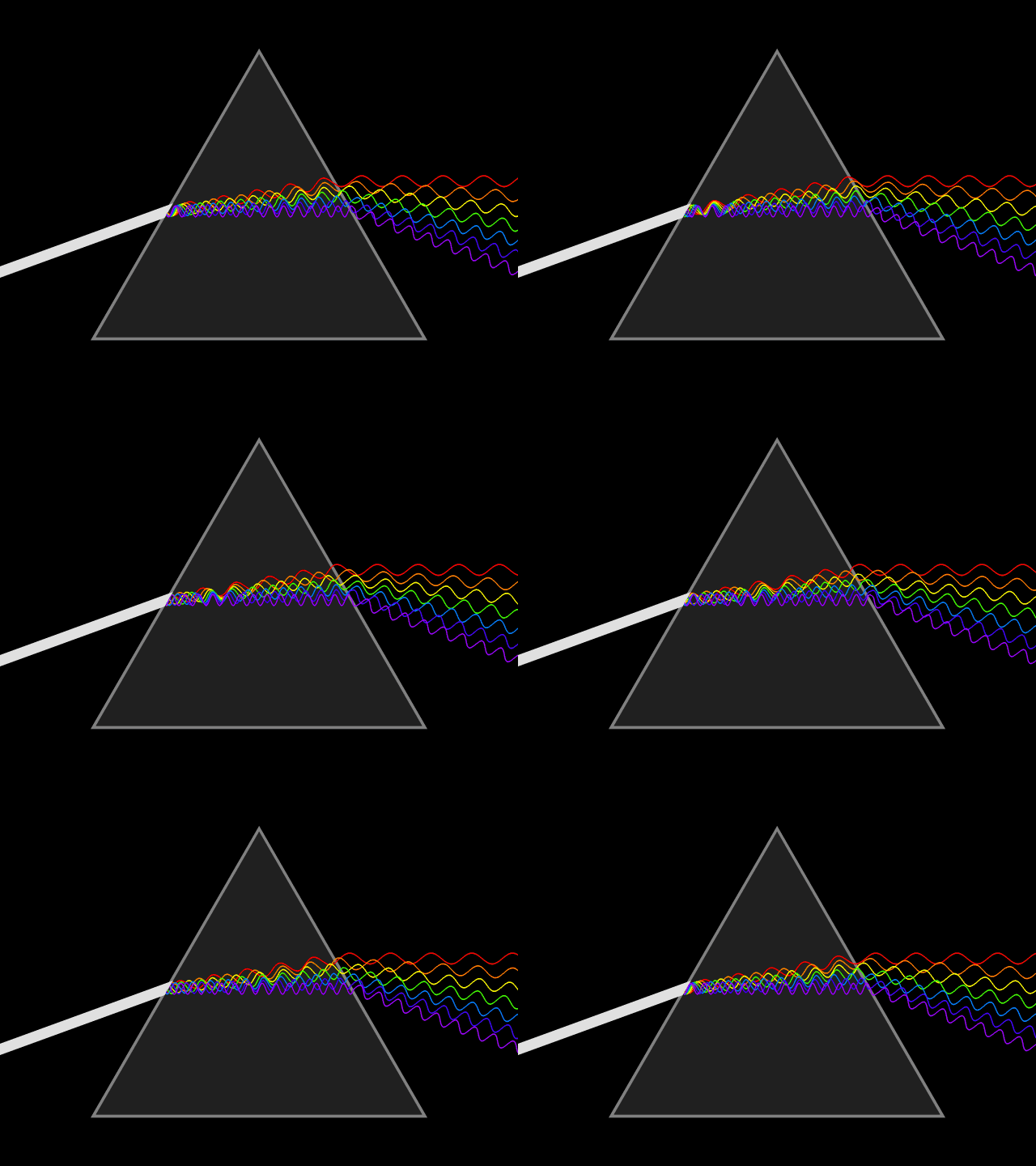
  • Visible Light Waves: this is the wave that your eyes can see, obviously. We think of colors as red, orange, yellow, green, blue, indigo, violet. Actually, that's organized into the lowest to highest energy: the colors of the rainbow. The reason we see wavelengths as color is because of type of cell called cones. Red light has the longest wavelength but the lowest frequency. Violet has the shortest wavelength and the highest frequency. They each represent a whole family of colors (bet they fight a lot), and all of them have a varying range of wavelengths. Did you ever know light was that complicated?
  • Ultraviolet Wave: has a shorter wavelength and higher frequency than light. Ultraviolet waves carry enough energy to cause a chemical reaction and they occur naturally from sunlight. A lot of ultraviolet rays come from the sun, but Earth's atmosphere (the ozone layer, which is why we need to take care of it!) stop most of the rays from reaching us tiny people down on Earth. ultraviolet rays also cause the aurora borealis, or the Northern lights, by shining through carbon dioxide in the atmosphere. Most people think that when it's cloudy, you can't get a sunburn. But you're wrong! Ultraviolet waves are strong enough and carry enough energy to penetrate and travel through clouds and go into skin. They can kill or damage cells, which causes sunburn, skin cancer, and cataracts. So, yeah, protect the ozone layer! It's way more important than you think.

  • X-rays: has a shorter wavelength and a higher frequency than a ultraviolet waves. They have a very high penetrating power. They can easily travel through almost anything. Doctors use a little bit of the x-rays to take pictures of your bones, because it's not as easy for the x-ray to travel through the bone than it is for it to travel through skin and muscle. The calcium in the bone stop the x-rays, actually. Scientists study blacks holes and star explosions by examining the x-rays they give off. Cool, huh?  
  • Gamma ray: this electromagnetic wave is the most energetic in the electromagnetic spectrum. It's a high-energy electromagnetic wave that has a shorter wavelength and a higher frequency than all the other types of electromagnetic waves. A lot of gamma rays come from outer space, and they are absorbed by our atmosphere. All matter is made up of atoms, and all atoms are made up from neutrons, protons, and electrons. So when the nucleus of an atom breaks apart or changes, or if it drops from one energy to another, electromagnetic radiation occurs. They're also produced in high-energy Earth explosions, like nuclear explosions. They do a lot of damage when they pass through living cells, which is why physicians use them to try and destroy cancerous cells. Gamma rays form in space during violent events, such as an explosion of a star, like x-rays. But radiation is bad. Trust me. That is not the way you want to die.
        The sources of the electromagnetic spectrum are accelerating electric charges. An example is the generation of radio waves by the electric charges in an antenna. Electromagnetic waves are made up of electric fields, which is kind of like the Earth's gravitational field but deals more with charges and magnetic fields. The electric fields come from a voltage, or a difference between two points in space, like a battery. Magnetic fields come from moving charges, like a current in a circuit. It's the combination and interaction of both fields that are a source.
        Now, a difference between microwaves and radio waves are the frequency at which they operate. Microwaves are basically in the ultra-high, super high, and extremely high frequency bands. But microwaves are radio waves. They're both used to transmit information. They're both vibrations in the electromagnetic field. It's only that microwaves have a higher frequency. The term microwave refers to a variety of frequencies in the radio spectrum from three hundred megahertz to three hundred gigahertz.
          And the difference between ultraviolet and infrared radiation is simply the wavelength. Infrared waves have a longer wavelength than ultraviolet waves...about one thousand times longer. It doesn't seem like a big difference, but trust me, it is.
        And that's all, folks. I know it was a bit long, but it's supposed to teach you something, right? Right. I definitely learned something if you didn't, so this wasn't a waste of my time. I hoped you enjoyed reading my blog, aside from the fact that it was a bit long. As always, my classmates' blogs are below, along with some links if you want to learn more. See you next time, I'm peacing out!
Katie's Blog
Logan's Blog
A Pretty Good Website
Webstie For Kids
Interactive Site


Monday, February 27, 2012

I HEAR YOU.....

        Hi, guys. How are you? I'm okay, but my poor poor ears are aching. This is because we found something on the internet that supposedly only kids can hear really loud, and all of my friends heard it, and it hurt like heck. My poor hurting ears. If the frequency of that sound was way higher, that could damage my hearing, and then I'd be mad. Can you imagine your life with out hearing? It'd absolutely suck, in my opinion. I dunno about you, but I love music, and simply listening to things, like birds singing, and I dunno what I'd do without it.

        How do you hear sounds, though? I mean, there has to be something other than getting the sound waves. It obviously has to do with the ear, and it must have some sort of process, right? And again, sound is something we all take for granted, so we ususally don't think about the whole process of it all, but it is interesting. Now, when you drop a phone book, you hear a thump! When you press the middle of a car wheel, you hear different kinds of horns: an uuuuurrrrrrr, an eeeeeeep, an brrrrraaaa and others. (Don't insult my skills; it's not easy describing car horns.) And when people open their mouths, you hear words. What you're hearing are sound waves.

        Sound waves are a vibration in the air around you. When something causes a disturbance, then the waves travel away from the disturbance, kinda like the ripples in a lake. Sound waves travel slower than light, but still pretty darn fast...at about 1,200 kilometers per hour. Cool, eh? Now, let's go to the ears. Here's what your head would look like if your body was see-through:


        Your ear is divided into three parts: the outer ear, the middle ear, and the inner ear. The outer ear is the only part of the ear that you can see (without machinery, of course). It's made of cartilage, something that's kind of rubbery. The little ridges of the cartilage help bounce sound waves to your middle ear. The pinna, the felshy part of the ear, collects the sound.
        FUN FACT: Because your ear is made of cartilage, not bone, when you see a skull, that's why there's no ears or nose.
        The sound waves travel through your ear canal and hit your eardrum, or your tympanic mambrane. The eardrum vibrates, almost like a real drum, causing the sound to amplify. The ear, actually, holds the three smallest bones in your body: the hammer, the anvil, and the stirrup. Not very imaginitive names, considering they're already used, but there's good reason for that. Okay, so the eardrums vibrations are sent to the hammer, which then moves back and forth really fast. The hammer hits the anvil, which sends its vibrations to the stirrup, which creates vibrations in the inner ear. It actually in the middle ear where sound energy is converted to mechanical energy.
        FUN FACT AGAIN: Babies can get earaches because of milk backing up the Eustachian tube, which causes bad bacteria to grow, and may cause awful hearing problems later in their life.

       The inner ear is covered with tiny hair-like particles, that, once damaged, can't be replaced. That's why you shouldn't put your music too high *coughKatiecough*. Anyway, the inner ear is sort of like a labyrinth. The vestibule and semicircular canals help with balance, and the cochlea helps you hear. The cochlea is like a seashell, almost, because it twirls. The cochlea transforms the vibration into electrical impulses, and then sends it to the brain, which then turns the signals into sound. That's what you hear.
        This all happens in less than a second. And that, people, is how you hear!
        However, if anything goes wrong---like if the hammer doesn't move back and forth, or the sound waves can't get to the eardrum, or the eardrum doesn't vibrate---then deafness can happen. Hearing is depends on a complex cycle of events. It's like building a pyramid out of cards. If you pull something out, the whole thing collapses. Even if you take something from the top, it's not a pyramid anymore, and therefore, it can't be called one.
        You may know this already, but deaf people use their own language, sign language. That's used with the hands, so they can communicate with other people. You may ask, why don't some use their voices? Surely they still work; I mean, it's just their ears that don't. Well, it's usually people that have been deaf since before or around the time they begin to learn to speak. They usually rely on visual methods of speech and have to go through speech therapy. While the vocal cords of those people are perfectly fine, it's a lot harder to speak correctly when you can't exactly hear yourself. It's sort of like if you have an iPod, and you can sing relatively well, but when you're singing with both headphones plugged in, then you're singing totally off-key. There's many other reasons, but this is about hearing, not speech. When we get into speech, I'll explain it.

ASL American Sign Language
        ANOTHER FUN FACT: kid can hear sound better than adults.  

The Range of Pressure That Can Be Heard By An Undamaged Ear
The ear is able of hearing a large amount of sounds. "The ratio of the sound pressure of the lowest limit that undamaged ears can hear to that of sounds that can cause permanent damage is more than a million. The decibel scale is logarithmic; it can be used to describe very large ratios."
DecibelsMicropascalsTypical Perception
0 dB 20µPa The quietest sound an 18 year-old healthy ear can hear
20 dB 200µPa A very soft whisper
45 dB 300 - 800 µPa A softly spoken voice
60 dB 5,000 µPa An average spoken voice
70 dB 20,000 µPa A shout
80 dB 100,000 µPa A noisy motorcycle on a narrow street
90 dB 500,000 µPa Jackhammers within 50 feet
100-120 dB 5.000.000 µPa A heavy metal rock concert
120 - 140 dB 20,000,000 µPa The noise of a jet engine within 250 yds.


Hearing LossNeed for a hearing Aid
Mild (cannot hear below 45dB) - soft sounds may be difficult to distinguish. None
Moderate (cannot hear below 60dB) - conversational speech is hard to hear, especially if there is background noise (such as a television or radio). Yes- Our hearing aids are excellent for helping you if you have this range of hearing loss, especially if you cannot hear in the 55-60DB range
Moderately severe (cannot hear below 75dB) - it is very difficult to hear ordinary speech. Yes- Our hearing aids are excellent for helping you if you have this range of hearing loss.
Severe (cannot hear 76-90dB) - conversational speech can't be heard. Yes- However, our hearing aids cannot help you if the hearing loss is this severe. You will need to see an audiologist.
Profound (cannot hear 91dB+) - almost all sounds are inaudible. Most people with profound hearing loss benefit from a hearing aid, while some don't. Yes- However, our hearing aids cannot help you if the hearing loss is this severe. You will need to see an audiologist.

                          I got both of the charts above from http://www.hearingcentral.com/howtheearworks.asp Link below.

        And that's all for today. Sorry for it not being as informative, but there's not really much else to do with how you hear, is there? Sorry. Anyway, as always, my classmates' blogs are always open for more information, and I'll put some links up in case you want to learn more. This includes the link where I got the chart, which is the best one I found. So, thanks for reading!
The Teenage Auto Test        
 

Monday, February 13, 2012

You SOUND like you want to learn more science! SOUND WAVES!

            Hiya. How're you? I'm good, and I kinda...sorta...hope you're okay too. Really, it depends on the person reading the blog. Now, today is about more waves, but we're going to be focusing on one wave in particular, so I'm not going to be repeating much. Just some, 'cause, you know, in that other blog I wasn't supposed to talk about the difference between noise and sound, though I'll include it in this one, too...enough chit-chat, let's get started.
Come on, you have to admit that's cool
              What do you think of when you think of sound? Music, television, movies, voices, fireworks...a lot of things have sound, and most of us underestimate sound and just expect it to be there. Can you imagine what your life would be like if you couldn't hear? Sound is incredibly important, and it's one of the five senses animals (which does include people) use to determine the surroundings of themselves, and they can use it to figure out who's near them, even if they can't see, though in my opinion, sight beats sound by a little. You always have sound, even when you sleep, and that kind of makes you dependent on it. Now, sound is a vibration that travels through air and water, and any medium (matter), really, but it can't travel through empty space, because there's no matter up there. That's why sound is a mechanical wave.
        Sound waves are characterized into four main parts, but there are many more, such as intensity:
  • Frequency: the number of waves produced by a vibrating sound per second. Measured in hertz.
  • Amplitude: Distance between the midpoint of the wave and the crest.
  • Waveform: the shape and form of a signal, like a wave, that moves in a physical medium.  

Sine, square, triangle, and sawtooth waveforms
  • Phase: indicates a certain point in the cycle of waveform. Measured in degrees.
  • 
  • Intensity: a measure of how forcefully an object vibrates. Measured in decibels. Every increase of ten decibels causes ten times increase in wave power. The rustling of leaves produces a sound of ten decibels. A whisper has a thirty decibels. A typical discussion usually produce sixty or sixty five decibels. A vacuum cleaner can have seventy five decibels. A lawn mower can produce one hundred decibels. Lots of traffic in the city has a sound that can be as loud as eighty-five decibels. Jam-packed nightclubs can go up to one hundred five decibels, and a rock concert is usually about one hundred twenty decibels. A jet taking off produces about...oh, one hundred fifty decibels.   
        Okay, that's over. Personally, I thought the intensity was pretty interesting, but that's just me. Moving on. So, why does the loudness of a sound wave change when the amplitude of the wave is increased? Well, loudness is relative to the ear, and age of the person. What I might consider loud, you might not. *coughKatiecough* However, the intensity of the sound or the dB measure is realated to the amplitude of the sound. The greater the amplitude, the higher the intensity.

        How does the wavelength of a sound waves affect the diffraction of the sound wave through an open window. Diffraction means the spreading out or bending of waves in the face of an object. So, the amount of defraction depends on the wavelength and the size of the object. So low frequencies, which has a long wavelength, 'diffract' around corners.

        Ever wonder how echolocation could be used to measure the distance to the bottom of the lake? Well, first off, what is echolocation? Echolocation is the location of an object or objects by reflecting sound. It's mainly used by dolphins and bats. Now, human echolocation is used by people to notice objects in the environment by sensing echos from said objects. Sonar is used to measure water depth. A transmitter sends out a short pulse of sound, and the reciever gets the refelcted sound. The depth of the water is found out from how much time has passed between the time the ultrasonic wave was released and the recievance of its refelction off of the bottom of the ocean, sea, or lake.


        Okay, so how does the spacing of particles in a sound wave change as the amplitude of the wave decreases? Well, when you space out the wave, the amplitude decreases. So, in other words, when the amplitude decreases, the space between the waves increase. It's really easy if you think about, and there's no other way to explain it.
        So, how does the wavelength of a sound wave change if the frequency increases or decreases? If the wavelength is reduced, then the frequency has to increase to balance it out. Another way to look at it is: the frequency of a wavelength changes with the wavelength depending on what happens to the wavelength. For example, if the wave length is doubled, the frequency is cut in half, and vice versa. So when it has higher freqency, it has a higher sound, and again, vice verca.  
        Have you ever been at school (what did you do? and why did you tell them I was here?), or at the park and heard a siren from an ambulance, police car, or fire truck? When that happens, you usually hear the pitch of the sound from an ambulance siren get lower, then higher. What is the motion of the ambulance relative to you? 
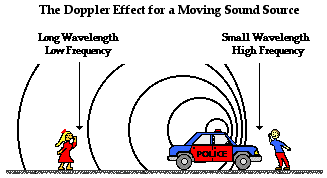
        The ambulance releases a sound at a constant frequency as it moves towards you. Constant freqency never actually changes, even though it sounds like the frequency is higher than what you're used to. Remeber: higher pitch equals higher frequency. So the frequency is the same, but the wavelength is compressed in the direction you're in because the ambulance is moving towards you. To your ears (misinformative things, they are), the compressed wavelength is the same as a higher frequency pitch. But when the ambulance passes you, as soon as it does, its velocity away from you causes the pitch to expand, which makes it sound like it has a lower frequency pitch. Who knew that an ambulance passing you was so complex? But once you know it, it really does make sense.
        All that is called the Doppler effect. The Doppler effect is "an increase or decrease in the frequency of sound, light, or other waves as the source and the observer move toward or away from each other." That is an incredible definition, and easy to understand. But, in other words: The Doppler effect is an increase or decrease in the amount of waves that pass a given point per second when the object and person either move towards each other, or away from each other. Yeah, I'm not good at that. But that's the Doppler effect. The pitch of a sound, when it's either high or low, is determined by the frequency of the sound waves as they hit your eardrum. Again, a high pitched sound is caused by sound waves that have a high frequency, and a low-pitched sound is caused by sound waves that have a low frequency.
        Now, what causes an echo? An echo is created when sound bounces off things. Of course, you probably knew that. That's not the only thing that causes an echo, though. After all, when you scream in your bedroom, it doesn't cause an echo, even though the sound is bouncing off the walls. Sound travels fast, about three hundred meters per second. Not as fast as light, but still, pretty darn fast. An echo that's really cool and good will come back to you after a couple seconds...that's the echo that'll scare Kate and Celine, because that echo will be eerie. To get a good echo, though, the sound needs to bounce of something at least seventy five meters away, otherwise it'll come back in less than half a second, and it won't make a very good echo-o-o-o-o-o.
        There's more, though. You can yell at a building seventy-five meters away until you die and still not get an echo. Why? Well, what has to happen is that a lot of the sound has to bounce back. What happens usually is that the sound exits your mouth, and travels for a while until it finally hits something. But the sound doesn't come out of your mouth in a strait line...it spreads in all directions. So only a little bit of your voice hits the building you're yelling at. If the building is too small, or your voice too low, very very little of your voice will hit the building. So it really doesn't matter if the sound bounces back or not. Even if it does, it will probably be too low for you to hear an echo.
       
        Worse, many solids don't bounce the sound evenly if they're rough. So the little bit of your sound that reached the building gets pushed and scattered in every direction possible.  

        So how do we hear an echo? To get an echo, sound has to follow a rule of reflection: it says that it will bounce at the exact same angle that it hits. If you want any sound that hits the wall to bounce back to you, it has to follow that rule. But it'll only work if the surface you're bouncing the sound off of is smooth.
        Even after that, you probably still won't hear an echo, because there isn't enough energy from the sound coming to your ear. So the echo is too soft, and will most likely be covered by all the sounds around you...wind, birds, cars, people, electronics...so much sound. You could, of course, hear the echo if all the sounds were quiet other than the sound coming from the wall. That can happen. Those sounds can be absorbed and never reach you if every sound around you had some sort of sound-deadener on it. That way everything would be quiet except for that sound coming to you from the wall. What's white, silent, and acts as a sound absorber and blanket? Snow!
  
        You probably notice that it's always so quiet after the snow stops falling. That's because the snow absorbs most of the sounds that are supposed to be travelling to you. That's a great time to get an echo anywhere in your yard. Shout at the building across from you. The sound that you can hear is only a little bit of the sound that bounced back from the building. There's more, though. I mean, you can't do that in the summer. Unless you go halfway across the world. You can, however, hear echos, even in the summer. How, though? There's no snow. To get an echo in the summer, you need something to amplify that. If you could get more, you could get an echo, even on a hot, noisy day. What you need, after the sound bounces off the wall, is something that it can bounce off of again. You need multiple walls or other flat surfaces that'll bounce more sound to your ear.
 
        So the sound that bounced of the wall comes back with more of your voice that bounced off the other walls. Or, what you can do, is go into a big, empty house and shout, echo-o-o-o-o-o-o-o! Now, we're almost done. All we need to know now is the difference between sound and pure noise. A lot of sounds are too high pitched or too low pitched for the human ear to hear. Almost everything creates a sound, even though we may not hear it. Sounds come in many forms: it can be from music, speech, and other things like film dialogue. A major thing to do with this is that we can increase or decrease the volume depending on our tastes with radio, television, movies, and other things made by man.
        However, noise is a horrible, irritating, and annoying sound, because in noise, different sounds are mixed together in a wild manner. It is really hard for the ear to create sense of the sounds that it hears from noises. If a person receives too much, noise can be deafening and extremely unhealthy for a person to what a lot of people call 'noise pollution.' Sound and noise are viewed differently, usually with sound looked at as something that causes pleasure. But when sound gets too loud or combines with other sounds, that's when noise comes in.

        And that's it! Sorry it was a bit long, and sorry I rambled a bit on the echo stuff. I thought it was interesting and cool. Now, as always, there are links to my classmates' blogs down below, and also more links if you want to know more about this sound wave stuff. Did you know that the average human can only hear sounds uo to one hundred twenty decibels? Pretty cool, huh? Er...sorry. There's also a link to a video SuperSara loves below. The video won't show up on the blog...don't know why. Anyway, thanks for reading my blog, folks! Or, thanks for being forced to read my blog, folks! Bye for now-ow-ow-ow-ow!