Tuesday, October 5, 2010

Acids and Bases

An acid: lemon
        Okay, so I have no idea what these words mean, so it looks like I'll be learning something as well as you! So... acids and bases. Good stuff, weird stuff, I-have-no idea-what-those-words-mean stuff, whichever you prefer.Personally, I'd go with the last one, but no matter. That can be changed, if you pay attention.
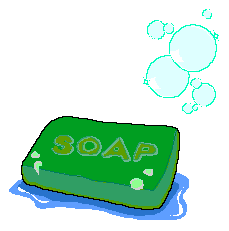
A base: soap
        Okay, so you know how lemon juice and vinegar taste sour? Well, for thousands of years, no one knew why. But now we know these are acids. The word acid comes from the latin word 'acere', which means 'sour'. In the seventeenth century, the Irish writer and amateur chemist Robert Boyle first labeled substances as either acids or bases. Here, mabe this will help:
  • Acids-taste sour, are corrosive to metals, change litmus red, and become less acidic when mixed with bases.
  • Bases- feel slippery, change litmus blue, and become less basic when mixed with acids.
        Okay, so maybe you're wondering what litmus is. Well, so am I, for that matter. So let me just look it up... ah, yes, here it is. Litmus is a dye extracted from lichens. Doesn't really help. So now I have to look lichens up. Great.... Perfect. It doesn't give a reasonable explination. This is what they gave me:
   "Lichens are made up of two, and some times three, different organisms from three different Kingdoms, which form a symbiotic relationship with each other for their mutual survival."
        Doesn't really make sense to me, but maybe it made sense to you. Right now, though, I have to tell you about bases. 'Kay, here we go.... That's interesting. They gave me a different definition. Here, I'll put it on, just in case you didn't get the first definition.
Acids:
  • react with zinc, magnesium, or aluminum and form hydrogen (H2(g))
  • react with compounds containing CO32- and form carbon dioxide and water
  • turn litmus red
  • taste sour
Bases:
  • feel soapy or slippery
  • turn litmus blue
  • they react with most cations to precipitate hydroxides
  • taste bitter
      

        So,if you'd like to know some common acids and bases here they are:
Acids:
  • lemon juice
  • vinegar
  • stomach acid
  • battery acid
  • many vitamins
Bases:
  • soap
  • dishwashing liquid
  • egg whites
  • ammonia
  • blood
        Alright, so if you don't know this already, there's something called a pH scale that you can use to tell how strong an acid or base is. The highest acid is a 1. The lowest acid is a 6. The highest base is a 14. And the lowest base is an 8. Water is nuetral. Here's a picture:
                
      
   Okay, so maybe you're wondering what happens if you mix them together. Well, the answer is relatively simple: the base will make the acid neutral, and vice versa.       


 P.S.  Here's a video, in case you wanna watch it:
        

An acid: vinegar

A nuetral: water

A base: laundry detergent

Monday, October 4, 2010

Physical and Chemical Changes

        Hello, people! Okay, so we're not completely finished with the periodic table of elements. The stuff I'm going to talk about today has the periodic table in it, but it's not all about the periodic table. So... chemical and physical reactions. It's pretty hard to understand, but not super hard. But, it is, in fact, high school stuff. So if you wanna get ready for high school, then be prepared! It's gonna get hard!
        Let's start with the basics. First up, chemical reactions! 'Kay, chemical reactions are basically when you make one thing change into another. Like, say you have a match and a piece of paper and you light the piece if paper on fire:


Paper on fire
         Okay, so when the fire consumes the paper completely, it will turn to ash. It can never change back into a piece of paper. That's a chemical change. A physical change is different. A physical change is a change in appearance. Say you have another piece of paper. If you crumble it up, it's still a pice of paper. You didn't change that.


Crumpled paper
        Now let's talk about products and reactants. But first, here's the real definition of a chemical and a physical change:
  • Chemical Change: produce new substances that have properties different of the original substances.
  • Physical Change: affects only it's physical properties, such as size and shape, or whether it's a solid, liquid, or gas.
  • Product: the substances that form as a result  of the reaction
  • Reactants: the substances that exist before the reaction
        I know this is hard to understand. I really do, seeing as I'm the one who has to learn it. Basically, a product is what you start out with, like a match and a piece of paper. A reactant is what you finish with, like ash. Here's a video:

Thursday, September 23, 2010

Oxidation and Reduction

        Hello. 'Sup.
        Okay, so we're going to learn about Oxidation and Reduction. Take a guess, anyone. Come on, don't be shy. Okay, fine. I guess I'll have to teach you. Oxidation is when one of those squares on the Periodic Table loses an electron. Reduction is when one of the squares gain an electron. Here's a video if you have thirteen minutes lying around:
 
        Okay, so the video told you a lot. But I seriously doubt that you have thirteen minutes lying around. So I'm going to explain more. There is this one group on the Periodic Table that loves to hog electrons. This group is: Nitrogen, Oxygen, and Fluoride. N.O.F. These guys love to hog electrons all to themselves. To quote Mr. Sellers: "It's basically like having a plate full of chocolate chip cookies. A guy named Hydrogen is giving them away, and a guy named Oxygen takes the whole plate and runs off."
Remember:
        Leo-Losing Electrons=Oxidation
            says
        Ger-Gaining Electrons=Reduction   
        Now, if it were real chocolate chip cookies, I'd take the plate and run too, but that's not the point. So Oxygen and Hydrogen bond together and form H2O, which, in case you don't know, is the chemical symbol for water. So, if you want to learn more, watch the video or read Anabel's and Jalen's blog. See ya! (Bed, here I come!)

Thursday, September 16, 2010

Stuff

        It's not about the Periodic Table, don't worry. Actually, worry. It's about the Periodic Table, kinda. I just felt like I owed you good news. 'Kay, we're learnin' 'bout the difference between a Metallic Bond and an Ionic Bond? Eet is wierd, but vhat ars you going to do? anabel was here. *Get off the computer! Get off! Come on! It's my blog!* Sorry 'bout tat. Tat vas obviously Anavel.
        Okay, no more vampire accent. Check out this video!

        'Kay, metallic bonding is the bonding with metals, obviously. It involves the delocalized sharing(A type of molecular bonding in which the electron density of delocalized electrons is regarded as being spread over several atoms or over the whole molecule. Also known as nonlocalized bond) of free electrons between metal atoms. Metallic bonds can be compared to salt. Iron is so strong bcause of metallic bonding.
        Ionic and covalent bonding are chemical bonding. Covalent bonding is the most common.
        Alright, if you wanna learn more about this stuff, go to Jalen's and Anabel's blog! Tee Hee!

Thursday, September 9, 2010

NOOOOOOOO! MORE PERIODIC TABLE STUFF!

        Yes, I'm here again to talk about *Deep voice* The Periodic Table of Elements! But I'm not here today to tell you the history of the periodic table. No, I'm here to tell you about one of the boxes on the periodic table. I'm here to tell you about HYDROGEN! YAY! (Mr. Sellers told me to be more positive.)
         You know, I had a person on my blog that I didn't know. If you know someone named 'roy01', or if you are 'roy01', please tell me on comment. Now, back to business. Alright, hydrogen. Okay, many of you know that H2O is made of two hydrogen atoms and one oxygen atom. If you don't, then I just told you.
        Atomic Number: 1
        Atomic Symbol: H
        Atomic Weight: 1.0079
        Even though pure hydrogen is a gas, we find very little of it in our atmosphere. Hydrogen is the lightest element. It is by far the most abundant element in the universe and makes up about about 90% of the universe by weight.
        Hydrogen as water is essential to life and it is present in all organic compounds. Hydrogen is the lightest gas. Hydrogen gas was used in lighter-than-air balloons for transport but is far too dangerous because of the fire risk (Hindenburg). It burns in air to form only water as waste product and if hydrogen could be made on sufficient scale from other than fossil fuels then there might be a possibility of a hydrogen economy.

Thursday, September 2, 2010

The Hardest Science I've EVER learned!

        Oh my gosh. I've done sooo many blogs, and most of them have been about atoms. Don't worry, people. We're almost done with atoms. Then we're gonna go on to a different topic, could be more interesting, could not, although anything harder than the periodic table, I can't imagine. So... the periodic table.
        The hardest science I've ever learned is The Periodic Table of Elements. Dmitri Mendeleev is considered the 'father' of the periodic table. He was born in Siberia, and he was the last born of fourteen children! I can barley tolerate the siblings I've got now, let alone fourteen. Oh, a picture of him, if you don't mind:

        I don't know what's with all the ugly people back then. I mean, seriously! Anywayz, his father went blind and could not support the family anymore. So his mother started a glass factory. Near the end of his high school education, Dmitri's father died and his mother's factory burned down. His mother took him to St. Petersberg, and worked day and night for his college education.
        In the late 1860's, Mendeleev began working on his great achievement: the periodic table of the elements. By arranging all of the 63 elements by their atomic weights, he managed to organize them into groups possessing similar properties. Where a gap existed in the table, he predicted a new element would one day be found and deduced its properties. And he was right. Three of those elements were found during his lifetime: gallium, scandium, and germanium.
       The periodic table of elements are divided into sections. Metals, non-metals, ect. The atomic number is the number of protons in an atom. *Yawn*So... where were we? Ah, yes. Here's a picture of the table thing:

        As you can see, because of the title of the picture, this is the periodic table of elements. Yay! Let's all celebrate! Not. Wanna know why? Because in high school, they're going to make you memorize that table. 'Course, I'll be in high school before you guys, and I'll visit you and tell you, it's not gonna be fun. Speaking of high school, if I can, I'll still be making blogs, even if I'm not in Shreiner anymore. But that's another two years. 
        Well, that's the basics. If this interests you, you can go to BrainPop to learn more about them. Our old friends Tim and Moby will be able to teach you. If you go on Anabel's and Jalen's blog, they'll teach you about them too. Well, that's all for now. Bye!
P.S. The chemical formula for water is H I J K L M N O. Hee hee. Get it? H2O? H-O? No? Fine.

Learn about animals!

Animals are amazing creatures. Unfortunately, many of our wild animals are endangered. A lot of them are extinct too. Some have just died out because of the change in weather, and some have died because we have hunted them to extinction. Some of our endangered animals are:
  • Tigers
  • Lions
  • Jaguars
  • Cheetahs
  • Leopards
  • Cougars
  • Brown Bears
  • Blue Whales
  • Giant Pandas
  • Sharks
  • Dolphins
  • Polar Bears
        And many, many more. We need to stop hunting all endangered species before they go extinct. The Dodo bird is one animal that has gone extinct, and many more followed. Think about it. What did we evolve from? Did we evolve from cars? Did we evolve from TV? Did we evolve from computers?No. We evolved from animals. So what are we doing? Are we selling our brothers and sisters for money? Are we killing our family for fur? Are we killing the one thing that ensures our survival? Yes. Yes, we are. You might have a different opinion, but that's my answer. Yes. My question is, how could we? How could we kill nature. And it's not only animals we're killing. It's trees and flowers too. We're killing the very things that help us breath. And what do we do once we cut down those trees? Do we plant new ones? No. We build houses and factories, which just adds more pollution in the air. If you want to see the planet you saw when you were little, the kind that's green, healthy, and full of life, help save the planet. make it a better place. Save Mother Nature.


"If you can't save the forest, plant a tree."